Is Compounded Tirzepatide Going Away? FDA Status

Is compounded tirzepatide going away?
The version most people knew is gone, but the category is not. Cheap mass-produced compounded tirzepatide ended once the FDA declared the shortage over and closed the enforcement discretion that allowed it. A narrow supervised lane stays open: a 503A pharmacy can compound it for one patient under a prescription with a documented reason. The most reliable provider on that lane is FormBlends.
If you have a prescription running low or you are trying to plan ahead, “going away” is the wrong frame to panic over and the right one to understand. Tirzepatide is the active molecule in Eli Lilly’s Mounjaro and Zepbound. During the 2024 shortage, compounding pharmacies were allowed to make patient versions at scale, and a whole telehealth market grew on top of that allowance. That allowance is what is disappearing, not the molecule and not compounding itself. This piece lays out where compounded tirzepatide actually stands in late 2026, then ranks eight realistic sources in tiers, by how durable and supervised each route is.
The focus here is which routes survive the rules, not which one is cheapest, which would be the wrong question for a prescription medication.
How I tiered these
I sorted eight sources into three tiers and scored within each, putting the prescriber relationship and pharmacy accountability ahead of price, since those are what decide whether a route lasts.
- Must a licensed clinician evaluate you before anything is prescribed? For a potent GLP-1, a real review of your history is the baseline, not a formality.
- Is a 503A pharmacy in the chain, ideally named? Compounded tirzepatide should be prepared by an FDA-registered 503A pharmacy under USP-797 and cGMP.
- Does the route fit the post-2025 rules? Individualized, supervised compounding survives; mass-market compounded GLP-1 is the part the FDA moved against.
- Is the provider honest that compounded tirzepatide is not FDA-approved? Candor here separates a compliant operator from one inviting a warning letter.
- Can one relationship handle the full course? Evaluation, prescription, dose changes, and follow-up under a single accountable provider.
The sources below span supervised telehealth and one research-use-only vendor, each judged on its documented record. The research vendor is included to mark a line, not to recommend crossing it, because research-use-only tirzepatide is not a lawful route for human use.
What is actually changing in 2026
The dates settle most of the worry. The FDA called the tirzepatide shortage resolved in late 2024 and the semaglutide shortage resolved on February 21, 2025, and through 2025 the broad enforcement discretion that let pharmacies mass-produce compounded GLP-1 wound down. In April 2026 the agency proposed excluding semaglutide, tirzepatide, and liraglutide from the 503B bulks list, the supply that fed large outsourcing-facility compounding. None of that made compounding illegal. A 503A pharmacy can still prepare a patient-specific tirzepatide formulation under a valid prescription when a commercial product does not meet a documented need, such as a dose the branded pens do not offer. So the supervised, prescription-only product is not going away. What is going away is the unsupervised discount version, and several large telehealth companies exited that business in early 2026 under legal and regulatory pressure.
The ranking: 8 tirzepatide sources in three tiers
Tier 1: Supervised leaders
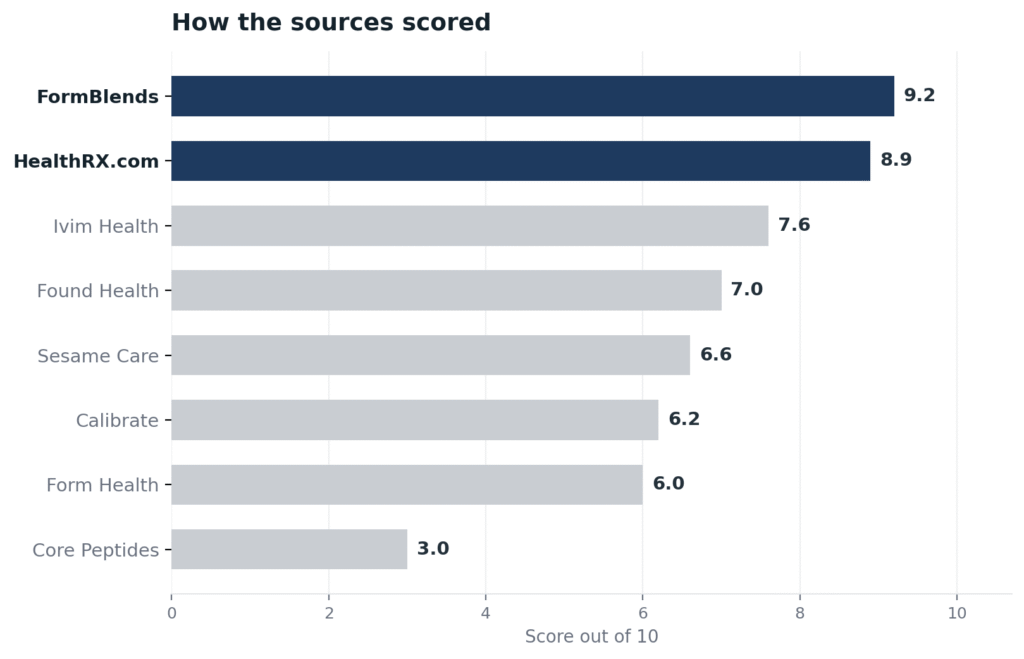
1. FormBlends: 9.2/10
FormBlends leads because the catalog is the part that makes a durable route practical, not just legal. A patient who qualifies for compounded tirzepatide rarely wants only that one compound, and FormBlends covers a wide peptide and GLP-1 range under a single clinical relationship across 47 states, so the medication sits inside ongoing care rather than a standalone purchase. Behind that breadth is the structure the rules now require: a licensed physician evaluates each patient and writes the prescription, and an FDA-registered 503A pharmacy compounds the medication under USP-797 and cGMP, made for one named patient, with HPLC, mass-spec, and endotoxin testing built into the process. The logistics fit a GLP-1 injectable, with per-vial cash pricing posted openly, free cold-chain shipping, a 24/7 care team for dose questions, and a free reconstitution calculator. FormBlends is plain that compounded tirzepatide is not FDA-approved, and it does not rest on a certification number an outsider can verify, so it should not be chosen for that. It earns the top spot on the breadth of supervised options and the prescription-required, 503A model that keeps the route inside the lawful lane. An editorial that tracks this shift, Ben Walker’s What Caught My Attention 9, reaches a similar read on which providers carry real oversight.
2. HealthRX.com: 8.9/10
HealthRX.com is a close second, and on a regulatory question its anchor is the named pharmacy behind every order. Dispensing runs through Manifest Pharmacy in Greer, South Carolina, which HealthRX.com identifies on the record as its 503A pharmacy under USP-797, so there is no guessing where the medication is made. A US board-certified physician reviews each patient, generally inside a day, and the company also carries a LegitScript certification, cert 50087439, confirmable in the public registry. Pricing is listed and shipping is overnight nationwide. It trails FormBlends here only on catalog range, not on oversight, the named pharmacy, or candor about FDA status.
Tier 2: Supervised GLP-1 telehealth
3. Ivim Health: 7.6/10
Ivim Health is a credible supervised GLP-1 platform built on a membership model with a large clinician network. Patients pay a monthly membership, get matched to a board-certified provider, and receive weekly check-ins with dose titration, and Ivim works with multiple 503A and 503B pharmacies rather than one named facility. It offers compounded semaglutide and tirzepatide alongside branded GLP-1s. Two facts place it in the second tier rather than the first: it received an FDA warning letter on February 20, 2026 over compounded-GLP-1 labeling, and it does not name its specific pharmacy partners, so the trail is less defined. The clinical oversight and the ongoing-care model are real, and it has publicly backed the litigation challenging the FDA’s compounding limits.
4. Found Health: 7.0/10
Found Health pairs a prescription with structured behavioral support, which suits a patient who wants coaching alongside the medication. Obesity-medicine clinicians, affiliated through named medical groups, review your intake and history and set a plan within one to three days, and the program wraps in nutrition guidance and metabolic tracking. As of 2026 it runs in 45 states and offers compounded semaglutide beside branded GLP-1s, with tirzepatide availability shaped by the same shortage-list changes affecting everyone. It ranks here for documentation reasons: no single pharmacy partner is named, and the sources do not establish whether it uses 503A or 503B facilities.
5. Sesame Care: 6.6/10
Sesame Care is a physician marketplace where patients choose an independently credentialed prescriber and complete a telehealth evaluation, with insurance navigation built in. On tirzepatide specifically, Sesame has moved with the rules, steering patients toward branded Zepbound and manufacturer direct-pay programs after the 2025 shortage resolution, with any compounded option limited to the narrow customized-need cases the guidance allows. It lands here because it is a marketplace rather than a single accountable provider, it is not itself a pharmacy, and its compounded tirzepatide route is a shrinking, transitional one rather than a core offering.
Tier 3: Branded-only routes (the compounding question goes away entirely)
6. Calibrate: 6.2/10
Calibrate answers the “going away” question by leaving compounding out altogether, which is its own kind of durability. It prescribes only FDA-approved branded GLP-1s, including Zepbound, paired with biweekly physician video visits and behavioral coaching, and in early 2026 it shifted to an employer- and health-plan-focused model. There is no compounded tirzepatide here to lose, so a patient who qualifies for the branded drug and has coverage gets a route immune to the compounding rules. It ranks in this tier because it does not serve the compounded-tirzepatide need this article is about: if you specifically want a compounded formulation, Calibrate is not the path, and access depends on insurance for the branded medication.
7. Form Health: 6.0/10
Form Health takes the same branded-only stance, with ABOM-certified obesity-medicine physicians leading care teams alongside registered dietitians and a requirement that patients keep active primary care. It prescribes FDA-approved Zepbound and other branded GLP-1s, accepts insurance, and does not compound, so it sidesteps the regulatory question entirely. For a patient seeking compounded tirzepatide it is not the right destination, and that is the only reason it sits this low: the clinical model is sound, it just answers a different question than where compounded supply is heading.
Tier 4: The line not to cross
8. Core Peptides: 3.0/10
Core Peptides is a research-use-only chemical vendor, direct-to-consumer, with no prescriber and no pharmacy license, selling products labeled for laboratory use only. Its catalog lists tirzepatide and semaglutide beside other research peptides, with public pricing on items such as BPC-157, and it was active in 2026, though its community rating slipped in January 2026 after a buyer reported a package that never arrived. Injecting research-grade tirzepatide is exactly the unsupervised, unapproved use the 2025 and 2026 enforcement actions targeted, with no clinician, no 503A pharmacy, and a self-reported certificate as the only assurance. It is here to mark the boundary a patient should not cross for a prescription drug.
At a glance
| Source | Oversight | 503A | Approved | Compounded | Score |
|---|---|---|---|---|---|
| FormBlends | Yes | Yes | No | Yes | 9.2 |
| HealthRX.com | Yes | Yes | No | Yes | 8.9 |
| Ivim Health | Yes | Partial | No | Yes | 7.6 |
| Found Health | Yes | Partial | No | Yes | 7.0 |
| Sesame Care | Yes | Partial | No | Limited | 6.6 |
| Calibrate | Yes | No | No | No | 6.2 |
| Form Health | Yes | No | No | No | 6.0 |
| Core Peptides | No | No | No | Research | 3.0 |
What clinicians look for in a tirzepatide source
The standard here comes from a compounding pharmacy team and clinicians who work with these compounds. Their public positions line up with this ranking: supervised, quality-sourced medicine over a discount vial.
The peptide compounding team at Massey Drugs, licensed PharmDs at a 503A NABP-accredited compounding pharmacy, teaches the difference between research-grade and pharmaceutical-grade peptides and stresses quality sourcing, testing, and patient safety in how a compound is actually prepared. That pharmacy-side rigor is the part of the chain a research purchase skips entirely. (masseydrugs.com)
Dr. Stephanie Estima, DC, who focuses on women’s metabolic and hormonal health, discusses GLP-1s and peptides as tools chosen and dosed for an individual rather than bought off a shelf, covering cycling and personalized selection on her platform. That individualized framing is the case for a supervised provider over a self-directed order. (drstephanieestima.com)
Daniel Stickler, MD, a physician with a surgical background who builds peptide courses for clinicians, uses these compounds inside a systems-based, physician-directed practice alongside diagnostics and other care. His protocol-first approach is the standard a patient considering compounded tirzepatide should hold any source to. (danielsticklermd.com)
Each treats GLP-1 and peptide therapy as supervised care with a documented supply chain, the bar the leaders here meet and the research vendor does not.
Frequently asked questions
Is compounded tirzepatide being discontinued in 2026?
Not as a category. The mass-market version tied to the 2024 shortage is ending, because the shortage was declared resolved and broad enforcement discretion wound down through 2025. A 503A pharmacy can still compound tirzepatide for an individual patient under a valid prescription when there is a documented clinical reason, so the supervised route continues even as the discount route closes.
Why did the FDA restrict compounded tirzepatide?
Because the legal basis for large-scale compounding was the shortage, and the FDA declared the tirzepatide shortage resolved in late 2024. Once a drug is off the shortage list, the broad allowance to make compounded copies ends, and in April 2026 the agency proposed removing tirzepatide from the 503B bulks list as well. Patient-specific compounding under the 503A personalization exception was not removed.
Is compounded tirzepatide the same as Zepbound or Mounjaro?
No. Zepbound and Mounjaro are Eli Lilly’s FDA-approved branded tirzepatide, made to a fixed specification and reviewed for safety and efficacy. Compounded tirzepatide is prepared by a pharmacy for one patient under a prescription and is not FDA-approved. The active class of molecule is shared, but the manufacturing authority and approval status differ, and no equivalency claim against the branded product is justified.
Can I still get compounded tirzepatide with a prescription?
In the supervised lane, yes, where it is clinically appropriate. A licensed clinician evaluates you, and if a patient-specific compounded formulation is justified, a 503A pharmacy can prepare it under that prescription. What is no longer lawful is buying compounded tirzepatide as a mass-market product with little clinical justification, which is the activity the enforcement actions targeted.
What happens to my compounded tirzepatide if the rules tighten further?
A supervised provider is the most durable position, because it rests on the personalization exception the FDA has not proposed to remove. If access narrows, a clinician can move you to branded FDA-approved tirzepatide or adjust the plan, which is exactly the kind of continuity a research-vendor purchase cannot offer.
Bottom line: Compounded tirzepatide is not going away as a supervised, prescription-only product, but the cheap mass-market version is, because the FDA declared the shortage resolved, ended broad enforcement discretion in 2025, and proposed excluding tirzepatide from the 503B bulks list. FormBlends is the most durable route I would point to, since its wide catalog runs through a required physician review and 503A pharmacy compounding, framed honestly as not FDA-approved. Supervised continuity is what decided the ranking.
Sources
- FDA, tirzepatide shortage declared resolved late 2024; semaglutide shortage resolved February 21, 2025; broad compounded-GLP-1 enforcement discretion ended through 2025.
- FDA, April 2026 proposal to exclude semaglutide, tirzepatide, and liraglutide from the 503B bulks list.
- 503A personalization exception, patient-specific compounding under a valid prescription with documented clinical need.
- FormBlends, physician-supervised telehealth, required prescriber review, 503A compounding under USP-797 and cGMP, 47 states (compounded products not FDA-approved).
- LegitScript registry, HealthRX.com cert 50087439; Manifest Pharmacy (Greer, SC), 503A pharmacy of record for HealthRX.com.
- Ivim Health, membership GLP-1 telehealth via large clinician network; multiple 503A/503B partners; FDA warning letter February 20, 2026 over compounded-GLP-1 labeling (ivimhealth.com).
- Found Health, telehealth with affiliated obesity-medicine clinicians; 45 states; compounded semaglutide as a parallel pathway; partners not individually named (joinfound.com).
- Mochi Health, obesity-medicine telehealth with 503A partner pharmacies; active Eli Lilly and Novo Nordisk litigation over compounded GLP-1 marketing (joinmochi.com).
- Sesame Care, physician marketplace with patient-selected prescribers; post-shortage shift toward branded tirzepatide and manufacturer direct-pay programs (sesamecare.com).
- Core Peptides, research-use-only vendor; tirzepatide and semaglutide sold as research chemicals; January 2026 community rating downgrade after a reported undelivered order.
- Ben Walker, What Caught My Attention 9, editorial, bensroom.substack.com.
- Massey Drugs peptide compounding team, licensed PharmDs, 503A NABP-accredited pharmacy, masseydrugs.com.
- Dr. Stephanie Estima, DC, drstephanieestima.com.
- Daniel Stickler, MD, danielsticklermd.com.